

UNP raises JVP’s past killings of monks in criticism of Buddhist reforms
The United National Party (UNP) has raised concerns over the Government’s proposed reforms relating to Buddhist institutions, including discussions on establishing Dhamma Courts and amending the Vihara-Devalagam Act.
In a statement issued today, the UNP questioned President Anura Kumara Dissanayake’s recent remarks supporting action against those accused of distorting Buddhism and called for wider consultation with the Maha Sangha and opposition representatives before implementing any reforms.
The party argued that existing constitutional provisions and traditional disciplinary mechanisms within the Buddhist clergy should be followed when addressing misconduct among monks. It also expressed concerns over what it described as a lack of consultation in the reform process and called for any changes to be carried out in accordance with established procedures and traditions.
The UNP further criticised the Government’s handling of several religious matters and urged authorities to engage with senior Buddhist clergy before proceeding with proposed legislative changes. (Newswire)
Full Statement
President Anura Kumara Dissanayake has recently publicly agreed to a call to take the same measures as previous kings in cases where the Buddhist religion is distorted under the guise of Dhamma.
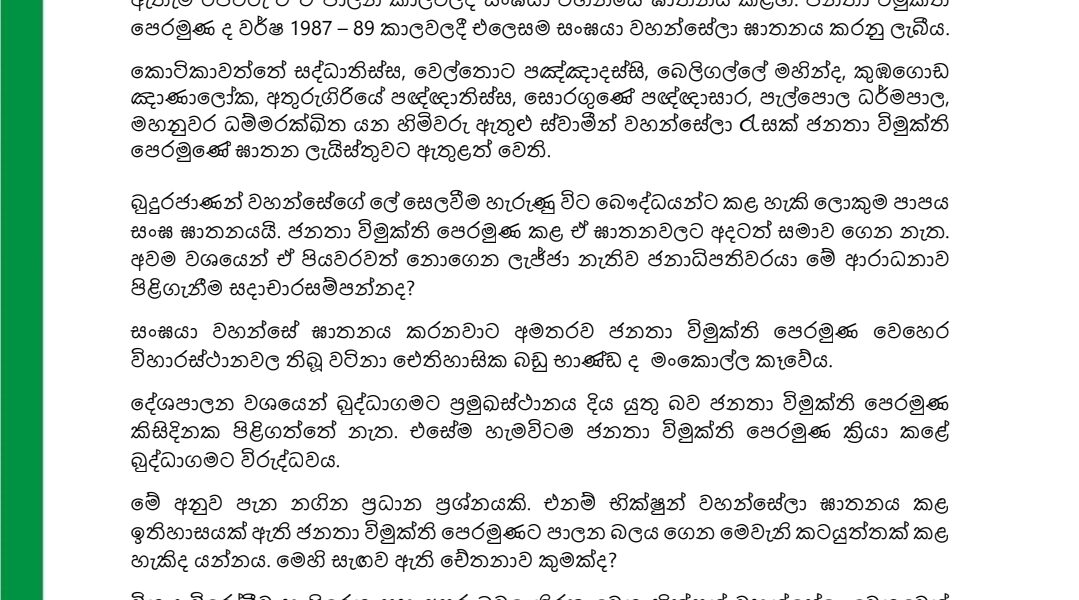
Over our history we have seen some kings kill the Sangha during their reigns. The JVP also killed the Sangha in the same way during the years 1987-89.
Kotikawatte Saddhatissa, Weltota Pangnadassi, Beligalle Mahinda, Kumbagoda Gnanaloka, Athurugiriya Pangnatissa, Soragune Pangnasara, Pelpola Dharmapala, Kandy Dhammarakkhitha and many other monks are included in the list of the JVP’s assassinations.
Apart from shedding the blood of the Buddha, the greatest sin that Buddhists can commit is the killing of the Sangha. The JVP has not apologized for the killings. Is it moral for the President to accept this invitation without first taking this step?
In addition to killing the Sangha, the JVP also looted valuable historical items from the monasteries and temples.
The JVP has never accepted that Buddhism should be given priority politically. The JVP has always acted against Buddhism.
A major question that arises from this is whether the JVP, which has a history of killing monks, can do such a thing after taking power. What is the hidden motive here?
Mr. J. R. Jayewardene took steps to include a separate chapter in the 1978 Constitution to take necessary measures for monks who behave undisciplined and engage in crimes. Provisions were made for the establishment of a Sangha Court to decide on the discipline of monks.
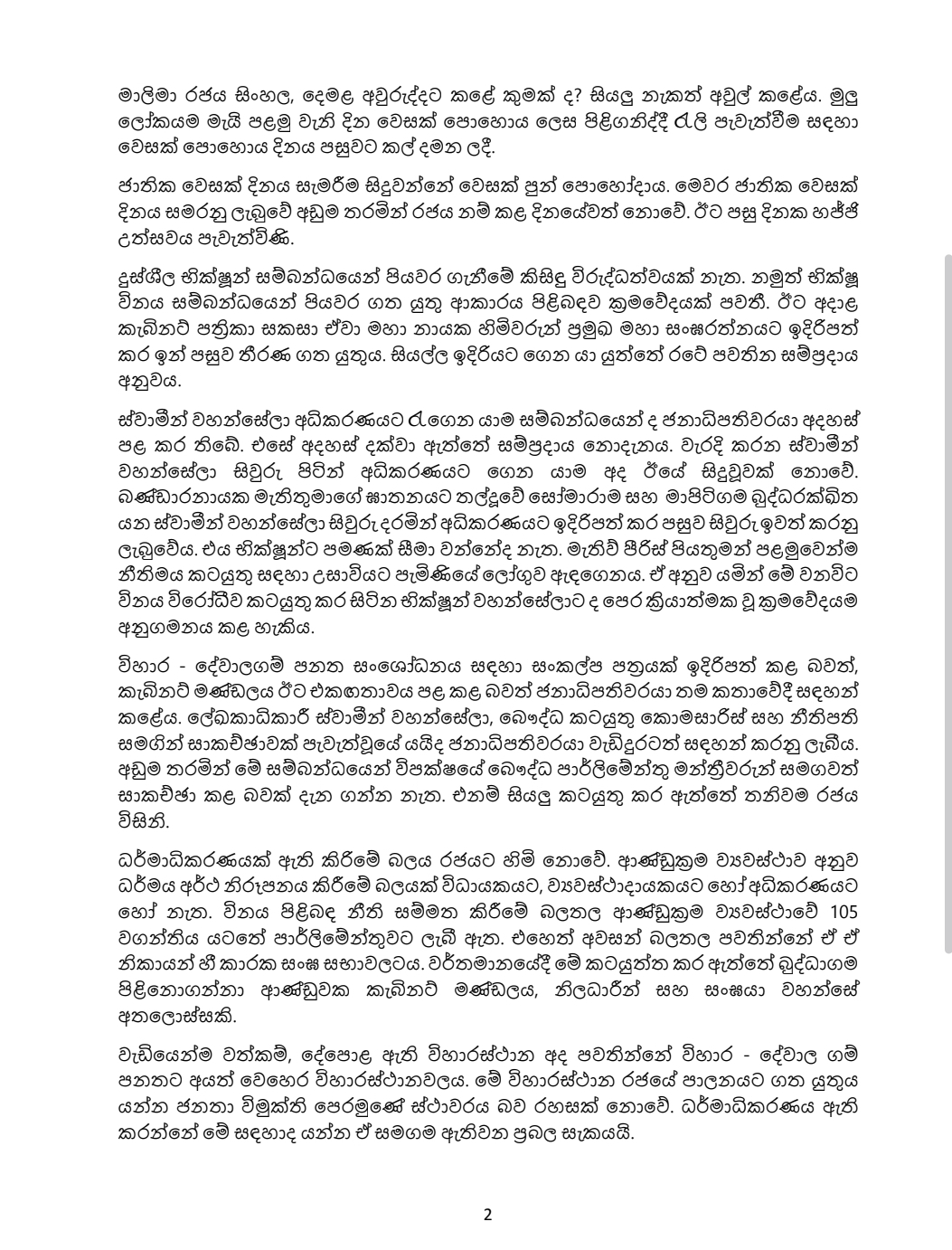
What did the NPP government done during the Sinhala and Tamil New Year? It disrupted all the auspicious signs. While the whole world was celebrating Vesak Poya on May 1st, the Vesak Poya day in Sri Lanka was postponed to a later date in order to hold political rallies.
The National Vesak Day is celebrated on the full moon day of Vesak. This time, the National Vesak Day was not celebrated on the day designated by the government, at least not on the day designated by the government.
There is no objection to taking action against unruly monks. But there is a procedure for how to discipline monks. Cabinet papers related to this should be prepared and presented to the Maha Sangha led by the Mahanayaka Theros and then a decision should be taken. Everything should be carried forward according to the existing tradition in the country.
The President has also expressed his views on taking monks to court. He has expressed such views without understanding the tradition. Taking wrong-doing monks to court in their robes is not something that only happened yesterday. Thalduwe Somarama and Mapitigama Buddharakkhita were presented to court wearing their robes for the assassination of Mr. Bandaranaike and later their robes were removed. This is not limited to monks. Father Mathew Peiris first came to court for legal proceedings wearing his robe. Accordingly, the monks who are currently acting in undisciplined manner must also follow the same procedure that was implemented earlier.
The President mentioned in his speech that a concept paper was submitted for amending the Vihara – Devalagam Act and the Cabinet agreed to it. The President further stated that he had held a discussion with the Registrar, the Commissioner for Buddhist Affairs and the Attorney General. It is not known whether he had discussed this matter with the opposition Buddhist parliamentarians. This work has all been done only by the government without any consultation.
The government does not have the power to establish a Dharma Court. According to the Constitution, neither the executive, the legislature nor the judiciary have the power to interpret the Dharma. The power to pass laws on disciplining the clergy has been given to Parliament under Article 105 of the Constitution. However, the final powers lie with the committees of the respective sects. At present, this work has been done by the cabinet, officials and a handful of monks of a government that does not accept Buddhism.
The temples with the most assets and properties today are in the monasteries and temples that fall under the Vihara – Devalaya Village Act. It is no secret that the Janatha Vimukthi Peramuna (JVP) is taking the position that these temples should be taken under government control. There is a strong suspicion that the Dharma Court is being created for this purpose.
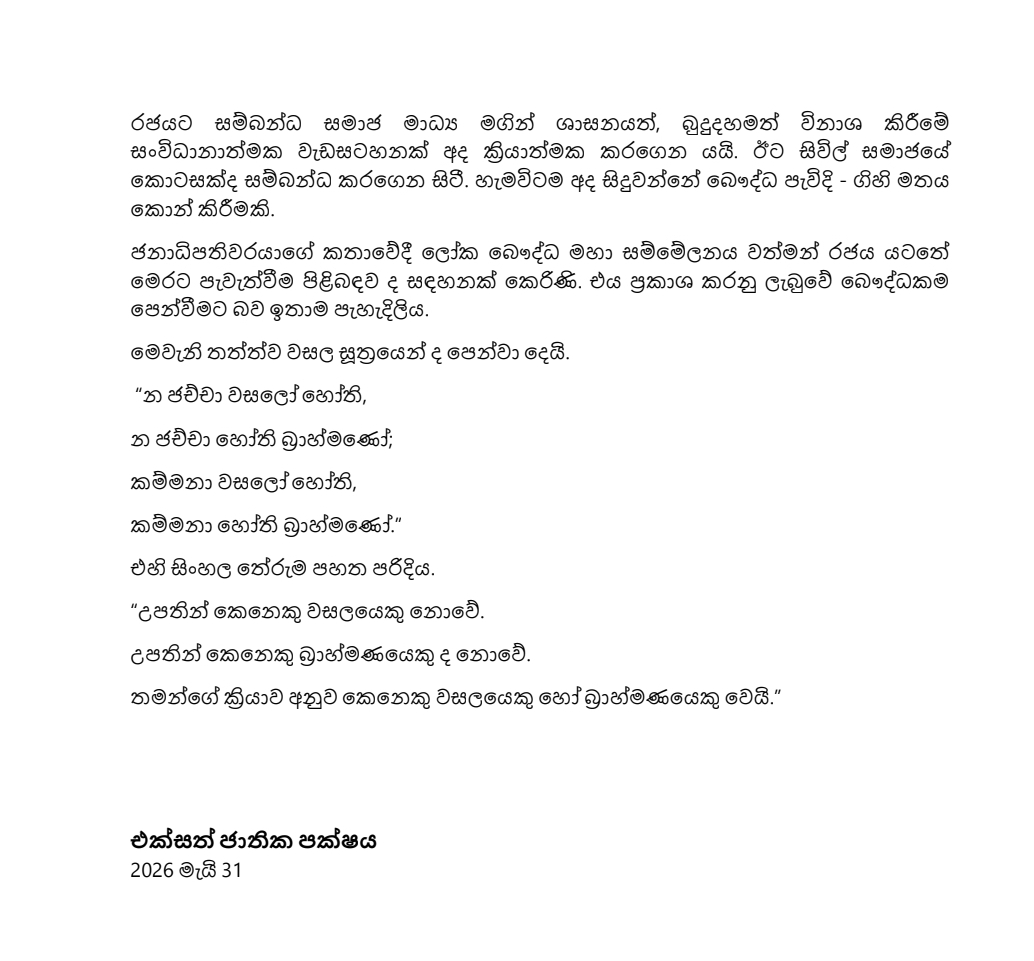
An organized program to destroy Buddhism is being implemented today through government-affiliated social media. A section of civil society is also involved in it. What is always happening today is the marginalization of the Buddhist monastic-lay opinion.
In the President’s speech, a reference was also made to the holding of the World Buddhist Congress in this country under the current government. It is very clear that it was announced to show Buddhism.
Such a situation is also indicated in the Vasala Sutta.
“Na jaccha vasalo hoti,
Na jaccha hoti brahmins;
Kammana vasalo hoti,
Kammana hoti brahmins.”
Its Sinhala meaning is as follows.
“One is not a householder by birth.
Nor is one a Brahmin by birth.
One becomes a householder or a Brahmin by one’s actions.”
The United National Party
31st May 2026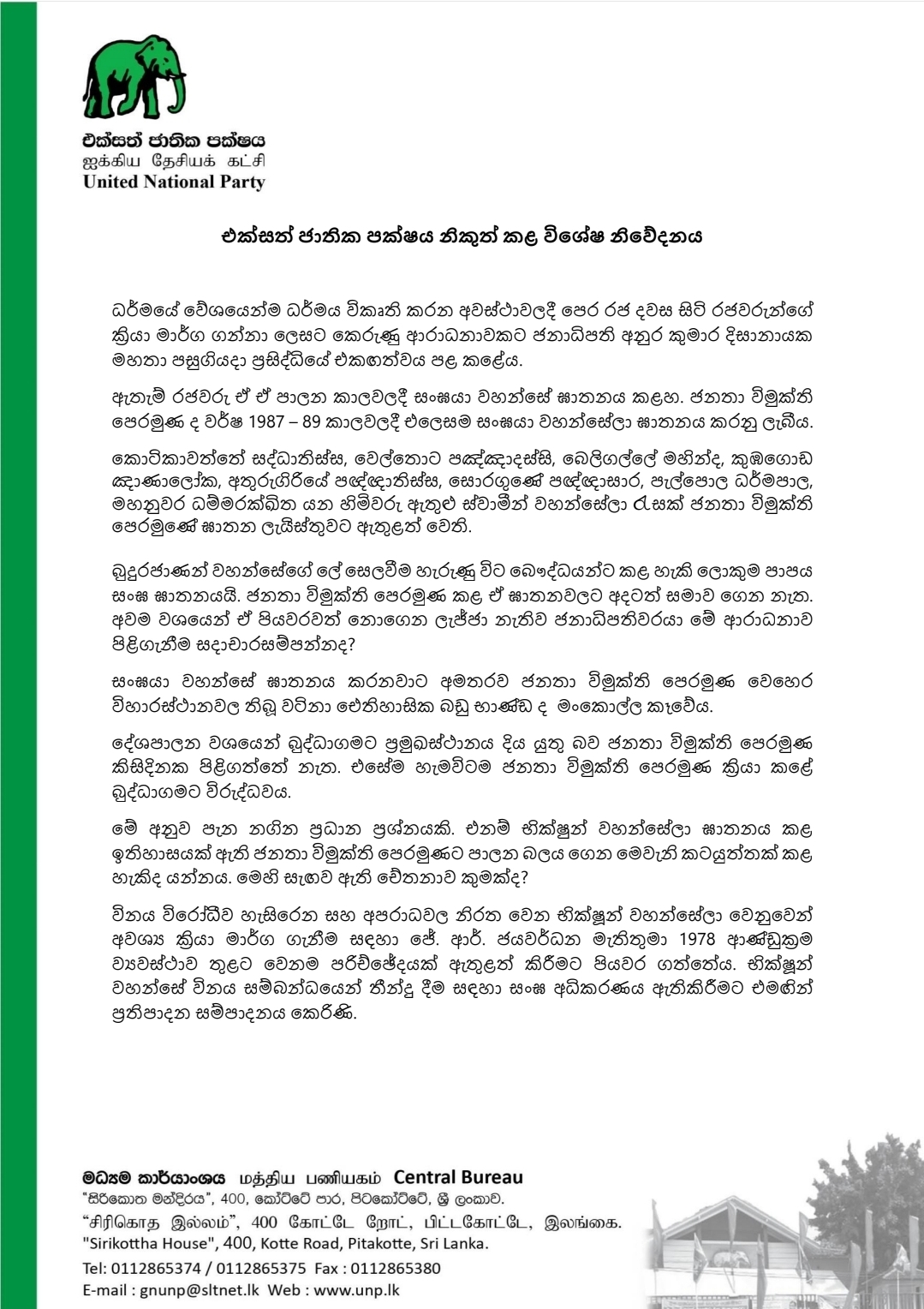
The post UNP raises JVP’s past killings of monks in criticism of Buddhist reforms appeared first on Newswire.