

Sri Lanka’s response to Iranian vessels: Key timeline of events
Sri Lanka will maintain a neutral stance in the ongoing Middle East conflict and will not allow its land, sea or airspace to be used in a biased manner by any nation engaged in the war, President Anura Kumara Dissanayake said on Thursday.
Addressing a special media briefing at the Presidential Secretariat, the President said Sri Lanka’s response to incidents involving Iranian naval vessels near its maritime zone has been guided by both neutrality and humanitarian considerations.
He said Sri Lanka will not hesitate to take action to protect human life while safeguarding the country’s sovereignty and international obligations.
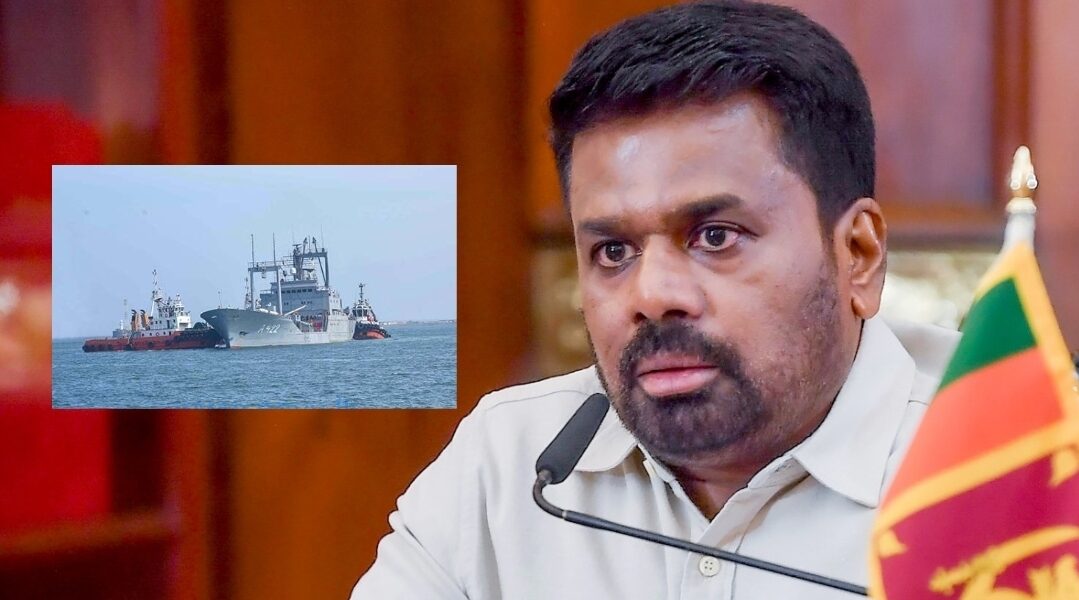
The President said the Sri Lanka Navy has begun disembarking 208 crew members from the Iranian naval vessel IRIS Bushehr, which is currently near Sri Lanka’s territorial waters. The crew will be brought ashore, while the vessel itself will be moved to the Port of Trincomalee after necessary arrangements are completed.
According to the President, the group includes 53 officers, 84 cadet officers, 48 senior sailors and 23 sailors.
He noted that Colombo Port was not selected to host the vessel due to its status as Sri Lanka’s main commercial harbour and the potential impact on maritime operations. Instead, the ship will be taken to Trincomalee following the evacuation of the crew.
The President also referred to an earlier incident involving another Iranian vessel that came under attack near Sri Lanka’s maritime zone.
- Key timeline of events
February 26
Iran requested permission from Sri Lanka’s Ministry of Foreign Affairs for three naval vessels to enter Sri Lankan ports between March 9 and 13 for a cooperation visit.
February 27
Sri Lanka was informed that a sailor on a vessel near Sri Lankan water’s (IRIS Bushehr) had been injured. The Sri Lanka Navy and Air Force transported the injured sailor and an accompanying officer ashore for medical treatment.
March 4 (early morning)
A vessel reported being attacked about 19 nautical miles off the Port of Galle and transmitted distress signals between 5:08 a.m. and 5:30 a.m.
March 4 (rescue operation)
Sri Lanka’s Navy and Air Force launched a rescue mission, rescuing 32 individuals and recovering 84 bodies from the incident. The injured were admitted to Karapitiya Teaching Hospital.
March 4
The Iranian naval vessel IRIS Bushehr requested permission to enter a Sri Lankan port after reporting engine damage.
March 5
Following discussions with Iranian authorities and relevant diplomatic channels, Sri Lanka decided to evacuate the vessel’s crew and move the ship to Trincomalee while bringing the crew ashore at Colombo.
The President said Sri Lanka’s decisions have been taken in line with international conventions including the United Nations Convention on the Law of the Sea and the Hague Convention.
He stressed that Sri Lanka will remain neutral in the conflict while continuing to act on humanitarian grounds, adding that the country will not allow external pressure to influence decisions that could endanger its people or maritime zones.
The President also called on all parties involved in the conflict to show commitment to peace, warning that the ongoing war risks causing significant global economic and humanitarian consequences. (Newswire)
Full Speech
Views expressed by President Anura Kumara Dissanayake at the special media briefing held at the Presidential Secretariat on 05 March, 2026.
Particularly in the context of this Middle East conflict, as well as in any international dispute, our position and neutrality dictates that we shall not, under any circumstances, permit our land territory, maritime zones, or airspace to be utilized in a biased manner by any nation engaged in a conflict, nor in any manner that inflicts harm upon another nation.
Accordingly, from the very moment this conflict began, the actions we have taken and the statements we have made have all been based on this position. It is in this context that the issue concerning two Iranian vessels has arisen. Even in this matter, the principle we continue to follow is neutrality. At the same time, as a nation and as a state, while safeguarding neutrality, we place humanity above all else. We will never hesitate to protect humanity. If there are actions that must be taken to protect human lives, we will not hesitate to take them under any circumstances. I believe that this is the best policy by which a state should be governed and we act within that policy framework.
On the 26th of last month, Iran requested permission from our Ministry of Foreign Affairs for three naval vessels to enter our port on the 9th to 13th of March, within a four-day period. This was described as a visit to enhance cooperation. However, upon our review, it became clear that these vessels were positioned close to, but outside, our national maritime zone. As everyone knows, a cooperation visit does not take place in such a manner; it requires extensive formal procedures. Therefore, we were studying those procedures. On the 27th, we were informed that a sailor on a vessel currently under our custody had suffered an injury. We were requested to bring that sailor and an accompanying officer ashore for humanitarian reasons. Accordingly, our Navy and Air Force intervened and brought both the injured individual and the officer providing care to land and they were directed to receive the necessary medical treatment.
Meanwhile, in the early hours of 04 March, between 5:08 a.m. and 5:30 a.m., it was reported that a vessel had come under attack outside but close to our maritime zone, approximately 19 nautical miles from the Port of Galle and that distress signals were being transmitted from that area. In response, our Navy and, in particular, our Air Force engaged in a major operation. In that operation, it must be said that we acted with both neutrality and humanitarian concern. Our forces intervened promptly and were able to rescue 32 individuals. The bodies of 84 deceased persons were also recovered. We brought both the 84 bodies and the 32 injured individuals ashore. The injured are currently receiving treatment at the Karapitiya Hospital.
Secondly, with regard to the IRIS Bushehr vessel, which is the subject of this briefing, it informed the Ministry of Foreign Affairs on 04 March that it was requesting permission to enter our port on the 4th and 5th. While we were discussing what course of action should be taken, our Minister of Foreign Affairs held discussions with the Iranian Minister of Foreign Affairs. In addition, the Iranian Embassy was in continuous discussion with our Ministry of Foreign Affairs.
Subsequently, they informed us that one of their engines had suffered damage. At that point, we engaged in discussions on how we should proceed. Within our national maritime zone, there are conventions and obligations that we must adhere to. On the one hand, this concerns a naval vessel belonging to one party in a war; on the other hand, we are a neutral state. How should a neutral state deal with such a vessel? In this regard, we continuously examined the authority vested in us and the actions available to us under instruments such as the United Nations Convention on the Law of the Sea and the Hague Convention of 1907. It must be clearly understood that this is not an ordinary situation. A neutral state, a vessel belonging to one party to a conflict and a request to enter our ports must be considered strictly in accordance with international conventions and international obligations.
Therefore, this is not a matter to be handled hastily. We must reach an understanding and agreement between the relevant parties in line with international conventions and commitments. Accordingly, discussions were held between the captain of the vessel and officers of our Navy. Discussions were also held with the relevant Embassies, with particular emphasis on keeping the Iranian Embassy informed throughout this process. Following these discussions, our proposal was that we were prepared to take custody of both the crew and the vessel, subject to agreements and understandings reached between the parties. A common agreement was also reached regarding the evacuation of the crew and the location where the vessel would be stationed.
Although the vessel was near the Port of Colombo, Colombo is our principal commercial port. Retaining such a vessel within our main commercial port carries the risk of adversely affecting our maritime industry. Therefore, we decided not to bring the vessel into the Port of Colombo, but instead to take it to the Port of Trincomalee. However, prior to taking the vessel to Trincomalee, we decided to bring the crew ashore at the Port of Colombo. Accordingly, one of our naval vessels has approached the vessel and the rescue operation is currently under way. According to the latest reports, arrangements have been made to bring 208 individuals ashore. This group includes 53 officers, 84 cadet officers, 48 senior sailors and 23 sailors. Steps have already been taken to transfer them from the vessel to our ships and bring them to the Port of Colombo.
Subsequently, with the necessary crew and in coordination with our naval personnel, we plan to take the vessel itself to the Port of Trincomalee. We will attempt to move the vessel to Trincomalee only after completing the necessary arrangements to bring this group ashore. Thus, we have adopted a very clear position. We do not act in a biased manner towards any state, nor do we submit to any state.
We are a sovereign and independent state. As a government, we have a responsibility regarding our seas, a responsibility regarding our state and a responsibility towards our people. These responsibilities are paramount. We must not make decisions that place our people or our maritime zones at risk. Therefore, the decisions we take are made with our people and our motherland as the highest priority. No matter what external outcries or pressures may exist, we do not panic or act recklessly.
Our position has been to safeguard our neutrality while demonstrating our humanitarian values. We do not believe that any civilian should die in wars. As a state, our approach is to value every human life as equal to our own. Our decisions have been taken accordingly. In this war, we wish to call upon all parties to demonstrate commitment to world peace. At this moment, dedication to peace is essential. People are dying and there is a risk of a severe global economic crisis. Due to the war, entire societies are facing serious and complex challenges.
What the world urgently needs today is peace. Therefore, we call upon all parties to show commitment to peace. As a state, we are ready to extend our support to every step taken towards that end. The actions we have taken are in line with this approach. I observed that throughout today there has been a great deal of misinformation, illogical claims, some presented as accusations, others as criticism or attempts to instil fear. Amidst all this, as a government, we have intervened in a manner that safeguards the reputation and dignity of our country, protects human lives and demonstrates our commitment to international conventions. That intervention is currently ongoing.
We firmly believe that this is the most courageous and humanitarian course of action that a state can take.
President’s Media Division
05.03.2026
The post Sri Lanka’s response to Iranian vessels: Key timeline of events appeared first on Newswire.